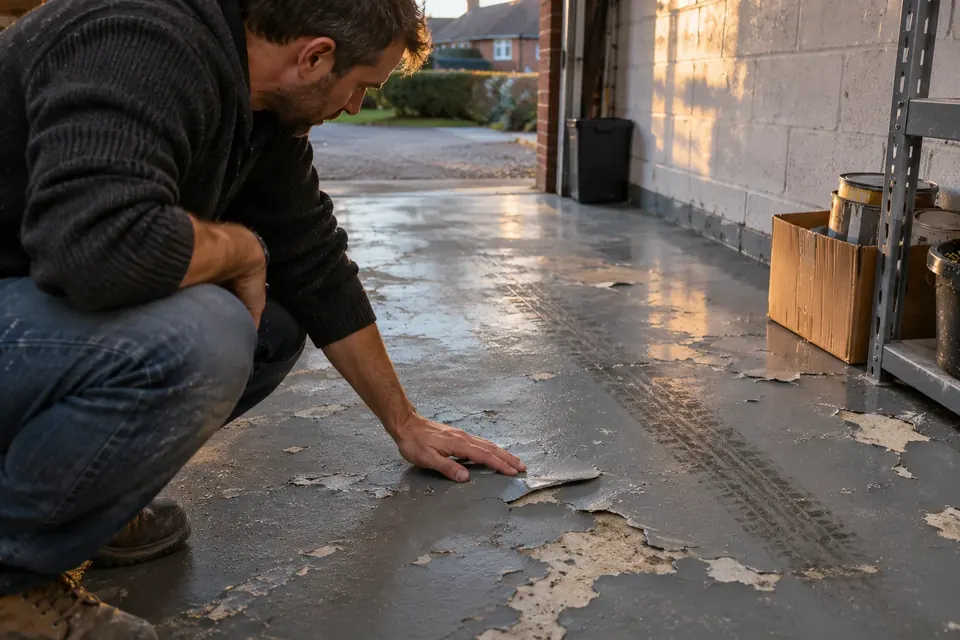
An epoxy floor usually peels because it never bonded properly to the concrete. The most common reasons are poor surface preparation, moisture coming up through the slab, coating over old paint or sealer and using the floor before it fully cured. Peeling is rarely fixed by patching over the top. The cause needs finding, the loose coating removing and the floor re-prepped before recoating.
Quick diagnosis
| What you see | Likely cause |
|---|---|
| Sheets lifting with clean concrete underneath | Poor prep, no mechanical grinding |
| Lifting with a thin grey dusty layer stuck to it | Laitance not removed |
| Blisters, white powder, damp patches | Moisture in the slab |
| Peeling in tyre tracks | Hot tyre pickup, thin coating or not fully cured |
| Old paint colour showing under the epoxy | Coated over failing old paint |
| Topcoat flaking off the colour coat | Recoat window missed or contamination between coats |
The common causes
1. Poor surface preparation
This is the big one. Concrete has a weak, powdery top skin called laitance. It’s also often contaminated with oil, tyre residue or old sealers. If resin is rolled straight onto that, it sticks to the weak layer rather than the concrete beneath.
Professional installers grind or shot blast to remove this and open the surface. Acid etching or a quick clean, common with DIY kits, often isn’t enough. If you can see a smooth, dusty layer stuck to the back of the peeled coating, prep is almost certainly the cause.
2. Moisture in the slab
Many UK garages and older ground floors have no damp-proof membrane. Water vapour rises through the concrete and builds up under a non-breathable coating, pushing it off. You may see blisters, a white chalky deposit or dark damp patches before it peels.
A good installer tests for moisture first and uses a moisture-tolerant primer or a damp-proof membrane system where needed. Without this, even perfect prep can fail.
3. Coating over old paint or sealer
New resin is only as strong as the layer it sticks to. Old garage paint or a cured sealer often looks fine but has a weak bond to the concrete. Put a new coating on top and the whole lot can come away together.
4. Hot tyre pickup
Car tyres get hot on the road. Parked on a thin or partly cured coating, they can soften it and pull it up when you drive off. This shows as peeling in the shape of tyre tracks. It’s most common with thin DIY paints or floors driven on too soon. See epoxy floor cure times.
5. Wrong conditions on the day
Cold, damp or very humid conditions can stop resin curing properly. Condensation on the slab before coating can stop it bonding at all.
6. Problems between coats
If too much time passes between coats or dust gets in, the next coat may not bond to the one beneath. This shows as the topcoat flaking off the colour coat rather than the whole system lifting.
Can a peeling epoxy floor be repaired?
Small, isolated areas
If the peel is local, for example a damaged edge or one oil-soaked patch, an installer may be able to cut back to sound coating, prepare the area and patch it. The repair will usually be visible to some degree.
Widespread peeling
If it’s lifting in several places, the bond has likely failed across the floor. The best fix is usually to grind off the old coating, deal with any damp, then lay a new system. It’s more work, but patching a failing floor tends to mean more peeling later.
Topcoat only
If only the topcoat is flaking, the colour coat may be sound. It can be abraded and a new topcoat applied.
How to stop it happening again
When you get quotes, ask:
- How will you prepare the surface? (Grinding or shot blasting, not just cleaning.)
- Will you test for damp? What will you do if it’s damp?
- Will the old coating be fully removed?
- What’s the cure time before I walk on it and drive on it?
- What does your guarantee cover?
Our list of questions to ask a resin flooring installer has more.
Was it DIY or professional?
DIY kits fail more often because they’re thinner and prep is usually lighter. If a professional floor is peeling within its guarantee period, contact the installer in writing with photos. Our post on DIY vs professional epoxy explains the differences.
Peeling on a business floor
Peeling in a warehouse, workshop or commercial kitchen is more than a looks problem. Loose edges are a trip hazard and lifting coatings can let water and dirt into the concrete. In food areas, a broken surface is harder to keep clean. Mark off the affected areas and get them looked at quickly. When you get quotes for the repair, ask how the installer will stop the same thing happening again, especially if the floor is regularly washed down or sees heavy traffic.
FAQs
Why is my new epoxy floor peeling?
Most new floors peel because of poor prep, damp in the slab or being used before they’ve cured. An installer should inspect it to find the cause.
Can you put new epoxy over peeling epoxy?
No. The loose coating must be removed first, otherwise the new layer will fail with it.
Does damp cause epoxy to peel?
Yes. Moisture rising through a slab without a damp-proof membrane is a common cause of blistering and peeling.
Is peeling covered by a guarantee?
It depends on the terms. Many cover workmanship and adhesion but exclude damp or misuse. Check in writing.
Find a checked installer near you
If your floor needs fixing, get someone who’ll find the cause. Find installers near you and check each firm’s Legit Score before booking a survey.